
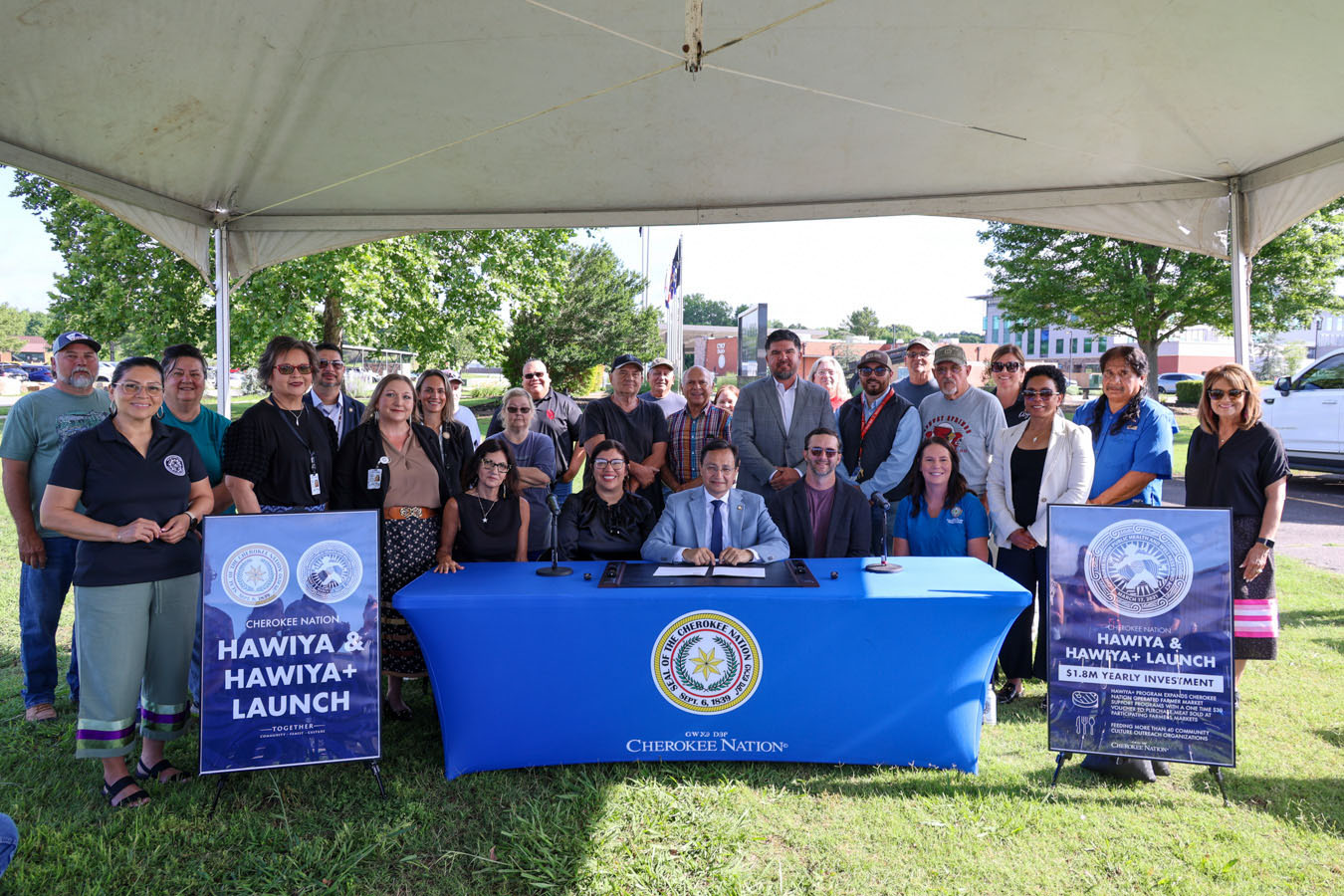
TAHLEQUAH, Okla. — Cherokee Nation Principal Chief Chuck Hoskin Jr. and Deputy Chief Bryan Warner announced today plans to tap the tribe’s Public Health and Wellness Fund Act to continue an expiring federally-funded community based meat distribution program and add one-time meat vouchers to the tribes’ low-income farmers market programs on a pilot basis.
“We do not want our mission to expand wellness to be dependent on whether federal funding is up or down,” said Chief Hoskin. “What we are building with the Public Health and Wellness Fund Act is a durable and renewable source of tribal revenue that enables us to think big, invest in generational terms and, in the case of the initiatives today, fund and evaluate pilot programs that show great promise.”
First enacted in 2021, the tribe’s Public Health and Wellness Fund Act earmarks 10% of the tribe’s annual third-party revenue collected by its health programs into a range of wellness investments and programs as well as grants to outside entities.
PHWFA has been responsible for constructing and operating the tribe’s new wellness centers, construction of walking trails and other outdoor recreation amenities and created new nutrition programs. PHWFA provided wellness infrastructure grants to local governments, schools and non-profits.
In January 2025 Cherokee Nation launched the Hawiya Food Sovereignty program, which utilized millions of dollars in funding from the U.S. Department of Agriculture to supply meat from the tribe’s 1839 Meat Company to the tribe’s network of independent Community and Cultural Outreach participating non-profits to assist community members with small amounts of meat each month.
Hawiya is the Cherokee word for “meat.”
Federal funding for the Hawiya meat program ran out last month after the funding agency declined to renew the program.
Hoskin, Warner and the Council of the Cherokee Nation worked together to amend the law last September to increase the PHWFA annual earmark for “wellness infrastructure and activities” from 7% to 10% and specified a broad range of uses, including food security programs.
“Under the Public Health and Wellness Fund Act we are looking at wellness in a more holistic way,” said Deputy Chief Warner. “That absolutely has to include nutrition. But we know that for many of our citizens affordability is an issue when it comes to proteins, so expanding the vision of the Hawiya program is a great investment.”
All CCO-participating non-profits are eligible to participate in the Hawiya program, and each has some flexibility in how the program - designed to primarily assist those not already on a public assistance food security program - is administered.
The following organizations will continue administering the Hawiya program under its new PHWFA funding source:
A total of 43 CCO organizations have participated, a list of them can be found here.
The Hawiya program represents an annual investment by the tribe of over $1.8 million.
“The Hawiya Food Security Program will continue helping close the gap for families who struggle with the rising cost of meat at the grocery store,” said Deputy Secretary of State Canaan Duncan. “But the program has also strengthened community organizing efforts in the participating communities because it gives local volunteers a powerful way to serve their fellow Cherokees by organizing to help provide essential protein.”
Chief Hoskin and Deputy Chief Warner also announced the expansion of two of the tribe’s public health department operated farmers market support programs under the new “Hawiya+” program. This program will launch in mid-June.
Cherokee Nation Public Health Administers a farmers market voucher program for Cherokee Nation citizens participating in the tribally administered Women Infant and Children nutrition support program and a separate program for Cherokee Nation elders.
Because the programs are primarily designed to encourage the consumption of locally grown fruits and vegetables, the Farmers Market Nutrition Program and Senior Farmers Market Nutrition Program have been limited to those items at farmers markets and not meat.
Under the policies signed by Chief Hoskin and Deputy Chief Warner on Friday, each program will receive a once per year $30 voucher earmarked specifically for meat sold at participating farmers markets in the program launching in June. The policies also call for both programs to continue on pilot stages using funds under the PHWFA.
“Our farmers market programs were already win/win for both participants who may struggle to afford healthy food, and local producers who need a strong local market to thrive,” said Executive Director of Public Health Lisa Pivec. “The Hawiya+ program puts more buying power into the hands of low-income moms and elders to purchase meat this summer.”
WIC participants and low-income elders interested in the Hawiya+ Farmers Market Program can contact Cherokee Nation Public Health at 918-453-5590 or
The Hawiya and Hawiya+ programs are pilot programs and could be expanded in the future.
“Because the Council and the Administration have a solid strategy under the Public Health and Wellness Fund Act, we can craft our own pilot food security programs outside of federal funding streams,” said District 3 Councilor Lisa Hall. “When those programs work, we can even expand them or we can change them as needed without being slowed down by federal red tape. I’m proud of the impact this program is making in our Cherokee communities.”
The Cherokee Nation Community and Cultural Outreach handed out meat Friday to eligible CCO participants, and the Hawiya+ program for low-income moms and elders will start in mid-June.