
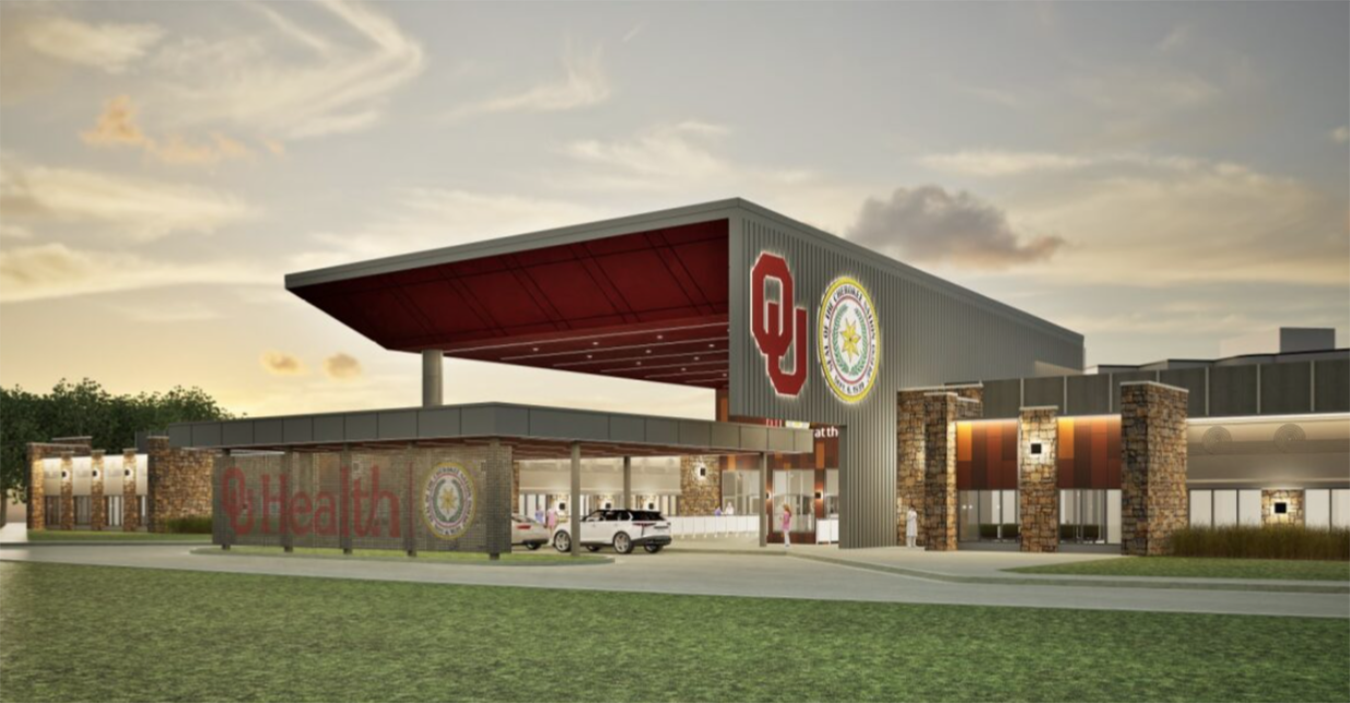
TAHLEQUAH, Okla. – Cherokee Nation Principal Chief Chuck Hoskin Jr. and Deputy Chief Bryan Warner proposed Monday to earmark $30 million for a satellite nursing school campus in Tahlequah through a partnership with the University of Oklahoma. The proposed legislation also aims to invest millions of dollars annually to train more nurses and other health professionals for jobs in the Cherokee Nation and rural Oklahoma.
“We cannot create a world class system of wellness if we do not maximize our healthcare workforce,” said Chief Hoskin. “The package sent to the Council to consider is a generational investment to ensure we have Cherokees entering the health profession in record numbers now and deep into the 21st Century.”
Chief Hoskin and Deputy Chief Warner proposed several measures under their “21st Century Cherokee Healthcare Workforce” plan, including:
- $30 million for a new University of Oklahoma College of Nursing satellite campus at the “Cherokee Nation Nursing and Allied Health Education Center” through a remodel of the current W.W. Hastings Hospital facility, which will be replaced by a new hospital by mid-2026.
- More than $5 million for a “Cherokee Nursing and Allied Health Scholarship” endowment to fund into perpetuity substantial student aid to Cherokee Nation citizens on a pay back basis through employment in the tribe’s health system.
- $1 million annually for new health field college scholarships and youth career exploration programs through the tribe’s Education Services Department.
- $1 million annually for non-degree health career training grants through the tribe’s Career Services Department.
“This plan is a win for the entire region, and a great near-term and long-term health workforce strategy for Cherokee Nation,” said Deputy Chief Warner. “Partnering with OU means we will bring world-class nursing education to everyone, generate nursing graduates to serve everyone in the region and put more Cherokees than ever in a position to find a career path in the health field.”
The Cherokee Nation Nursing and Allied Health Education Center and Endowment Act authorizes Cherokee Nation to agree with a third-party provider of collegiate-level education in nursing and other health fields. Chief Hoskin and Deputy Chief Warner announced that the tribe is in talks with OU to operate the new center.
“We deeply value the Cherokee Nation’s leadership and vision in strengthening the healthcare workforce in Oklahoma. Strengthening Oklahoma’s healthcare workforce is a core pillar of the University of Oklahoma’s Strategic Plan. The university has made a sustained commitment to educating and advancing nurses into the healthcare workforce as a critical part of improving health across our state,” said University of Oklahoma President Joseph Harroz Jr. “As the state’s flagship university, we are proud to collaborate with tribal nations to expand access to high-quality nursing education. We look forward to working with the Cherokee Nation to advance nursing education and a strengthened workforce for the Cherokee Nation and the communities it supports.”
The proposed law would provide $5.15 million in an endowment for nursing and allied health education through the tribally affiliated Cherokee Nation Foundation. Eligibility for the scholarships will be open to Cherokees across the United States, but students who aim to join Cherokee Nation’s health workforce will receive a preference.
“The main goal with the new endowment is to create a perpetual source of funds to send Cherokees, no matter where they live, to get their education at low or no cost and pay the tribe back by joining our amazing healthcare workforce,” said Cherokee Nation Chief of Staff Dr. Corey Bunch.
Chief Hoskin and Deputy Chief Warner propose tapping $2 million annually from the tribe’s Public Health and Wellness Fund Act to fund more health career education and training.
Under proposed amendments to the tribe’s Comprehensive Scholarship Act, the tribe’s Education Department will use $1 million of that fund annually to fund health field scholarships and youth career exploration programs, all without limitation on the student’s residency.
Under proposed amendments to the tribe’s Career Readiness Act, the tribe’s Career Services Department will provide $1 million in annual grants and other support to assist Cherokee Nation citizens to obtain non-degree career training in health fields. The amendments would also give the department new flexibility to extend services beyond the tribe’s reservation boundary to meet regional workforce needs.
The proposed new college and career funding earmarked for health fields comes on top of millions of dollars Cherokee Nation and the Cherokee Nation Foundation provide annually for scholarship and job training assistance.
Scholarship funding through the tribe’s primary scholarship fund last year was nearly $25 million. Last year its Career Services Department provided over $12 million in career training support. The Cherokee Nation Foundation provided $550,000 in scholarships.
The Council of the Cherokee Nation will consider the three pieces of legislation later this month.
“The Council has helped shape a great deal of health and education policy and funding in recent years, but this may be one of the most impactful investments we’ve played a role in,” said Speaker of the Council Johnny Jack Kidwell. “We have an opportunity to give a hand up to a generation of Cherokees to receive education and training before, hopefully, coming home to work for us as we continue expanding our health system.”
If the plan is approved, the $30 million remodel and upgrade of the W.W. Hastings facility will begin immediately after the current hospital operations in that facility transfers in the summer of 2026 to the tribe’s new $450 million newly constructed hospital located on the same medical campus in Tahlequah.
The tribe and OU plan to begin the new nursing school cohorts before the facility is completed, with the online classes beginning in the fall of 2026. The remodeled and upgraded home of the OU nursing school in Tahlequah is estimated to open in 2027. The focus of the new nursing program will be RNs with associate degrees as well as LPNs who wish to obtain their Bachelor of Science in Nursing. As the program grows, the goal is to open to a wider range of student needs with basic nursing prerequisites to those holding non-nursing bachelor’s degrees.
Cherokee Nation operates the largest health system in Indian Country, available to members of every federally recognized tribe with over 3 million patient services per year.