
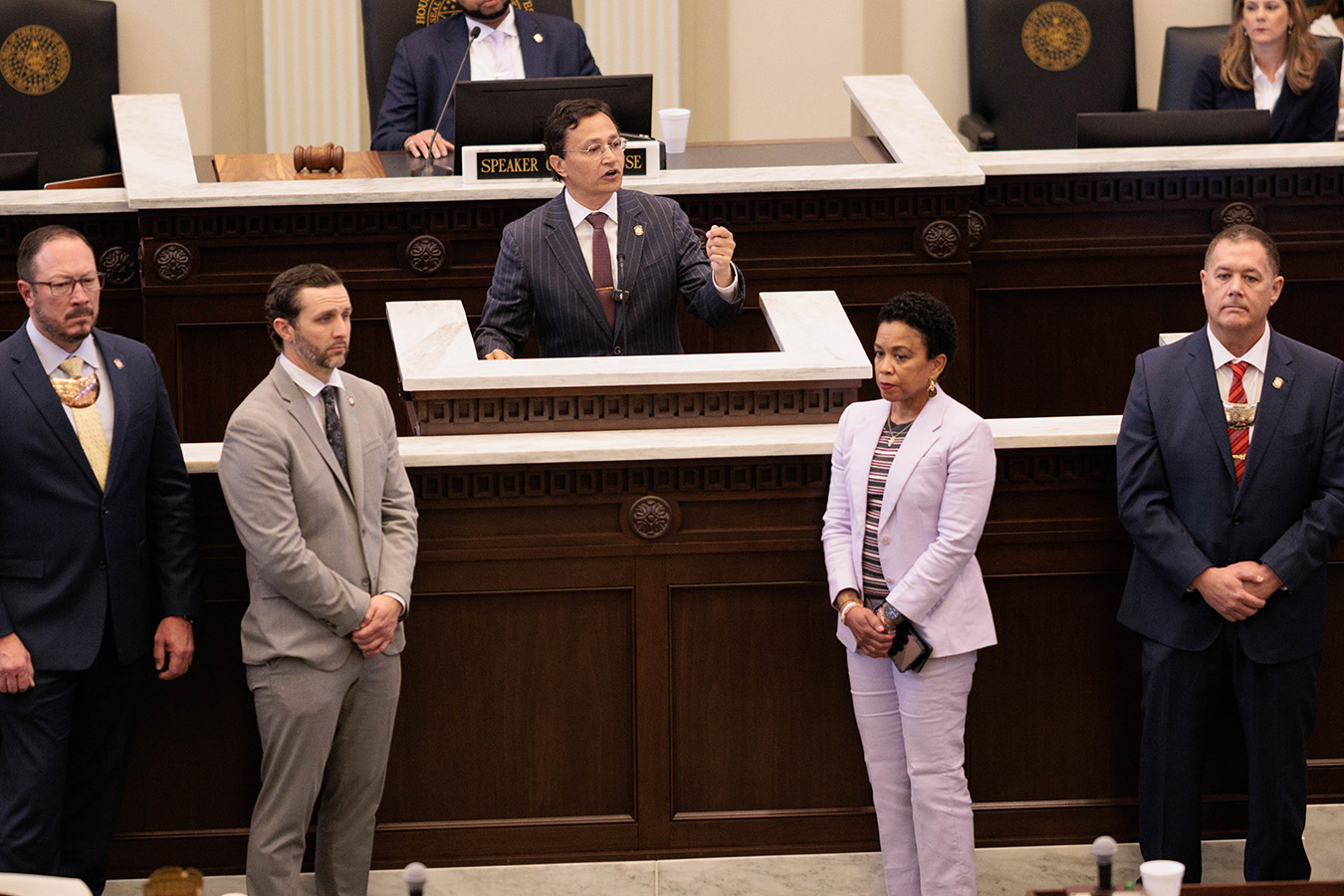
Oklahoma City, Okla. — Cherokee Nation Principal Chief Chuck Hoskin Jr., Deputy Chief Bryan Warner, and the Council of the Cherokee Nation met with state lawmakers during Cherokee Nation Legislative Day at the Oklahoma State Capitol this week to discuss the tribe’s legislative priorities, including the protection of Medicaid expansion.
Among the tribe’s legislative priorities this year is opposition to the passage of House Bill 4440 and House Joint Resolution 1067, which seek to reverse Oklahoma voters’ 2020 expansion of Medicaid by using the tactic of placing it on an expedited August special election ballot.
Chief Hoskin, Deputy Chief Warner, and other tribal leaders visited both the House and Senate floors, where Chief Hoskin addressed Oklahoma lawmakers to highlight the contributions that Cherokee Nation makes not only for tribal citizens but for all Oklahomans.
Chief Hoskin’s address included updates on the tribe’s investments in education, housing, workforce development, childcare, and health care, highlighting the importance of Medicaid expansion and third-party revenue being reinvested into the new W.W. Hastings Hospital infrastructure and other vital services.
“Third-party revenue generation is the key to funding our health initiatives, enabling us to establish clinics in underserved communities, hire doctors and nurses, and bring healthcare services to areas that have never had access to them. Medicaid expansion has created over 1,400 jobs, over $92 million in wages, and has generated over $222 million in total economic impact within the Cherokee Nation Reservation.” Chief Hoskin said of direct funding from Medicaid expansion.
“While there are valid concerns about the cost of Medicaid expansion, the state of Oklahoma cannot afford to lose this vital program, and I will do everything in my power to protect it,” Chief Hoskin told legislators. “The effort to push for a repeal of Medicaid expansion is a direct threat to rural healthcare, the Cherokee Nation’s health system, and the quality of life for all Oklahomans.”
Cherokee Nation Health Services provides more than 3 million patient services annually.
In 2025, the Cherokee Nation health system supported nearly 17,000 Medicaid expansion patients, providing over 113,000 medical visits, 10,000 dental services, and 143,000 pharmacy services.
Because Indian Health Service are reimbursed at a 100% federal match, this revenue comes at no cost to the state of Oklahoma. Its removal would therefore not yield state savings but would instead eliminate federally sourced capital flowing directly into rural health care systems.
Cherokee Nation is also advocating for the passage of Senate Bill 1721, which seeks to extend the sunset of the Oklahoma Advisory Council on Indian Education for three years and clarifies representation requirements for members serving on the council.
“These issues are very important not just to the Cherokee Nation but to our neighbors, other tribes, and non-natives living in the state of Oklahoma,” said Deputy Chief Bryan Warner. “We must remember how we are tethered to one another and let the spirit of Gadugi help us to work together to find solutions for our great home state.”
Chief Hoskin also thanked the Oklahoma legislature for the friendship between the Cherokee Nation and the state of Oklahoma as one of the most important relationships in the state.
“In this century, we can achieve remarkable things that are beyond the capabilities of any single entity. The Cherokee Nation cannot accomplish these goals alone, and neither can the state of Oklahoma. There will be days ahead when we will have chances to collaborate and make this state even better than it is now. I assure you that the Cherokee Nation’s friendship is enduring, and we will be there for you. Together, we will ensure that this great century for the Cherokee Nation is also a great century for the state of Oklahoma,” Chief Hoskin said.