
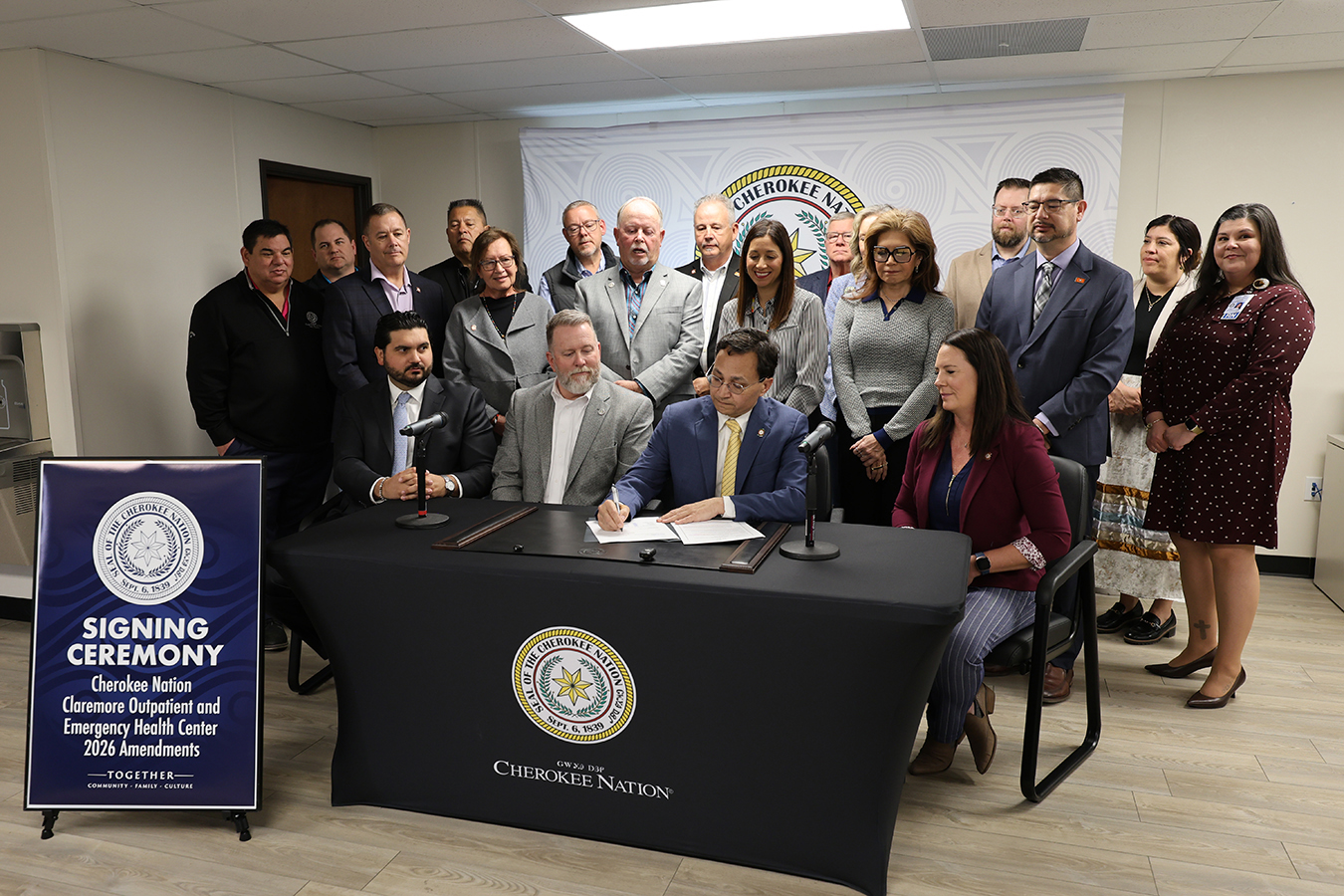
CLAREMORE, Okla. — Cherokee Nation Principal Chief Chuck Hoskin Jr. signed into law an amendment to the Cherokee Nation Claremore Outpatient and Emergency Health Center Act of 2025, increasing the authorized construction budget from $255.5 million to $400 million to expand the new facility that will replace the former Claremore Indian Hospital.
Chief Hoskin signed the legislation during a ceremony in Claremore on Monday, Feb. 2, after Council of the Cherokee Nation approved the amended legislation last week. The increase expands the construction for patient growth and new services and matches the tribe’s investment in the new W.W. Hastings Hospital in Tahlequah, reflecting a commitment to excellence across the Cherokee Nation Reservation.
“When we took over operations at Claremore, we promised the Cherokee people and all Native families in this region that we would deliver a health care facility worthy of their trust,” Chief Hoskin said. “Increasing this investment to $400 million ensures we can build a facility that not only meets today’s standards but is designed to serve our growing community for generations to come.”
The amendment raises the authorized expenditure ceiling through the end of fiscal year 2028. The tribe is funding the entire Claremore Outpatient and Emergency Health Center project with its own tribal general funds, without the need of borrowing or seeking federal funding.
Chief Hoskin and Deputy Chief Bryan Warner first proposed the construction of a new replacement facility in 2025 as part of the tribe’s assumption of operations at Claremore Indian Hospital, which had been owned and operated by the federal Indian Health Service. The original legislation was signed into law on June 26, 2025, with unanimous Council support, authorizing $255.5 million for the project, including property acquisition and health and safety improvements to the existing facility.
Since Cherokee Nation assumed operations in October 2025, the Claremore campus has experienced strong and steady growth in patient access, visits and available services. In January 2026, the facility saw more than 13,000 services, already exceeding the level of patient service provided under IHS. The Primary Care Clinic alone has grown from 3,990 patients in October to 5,486 in January, with new patient appointments scheduled into March and April. The facility’s call center is averaging 800 calls a day, with some days seeing more than 1,600 calls from patients seeking care.
An analysis conducted by Optum confirmed that the original facility design was undersized for the demand that emerged after the tribe assumed operations. The Optum assessment estimated demand volume of 1.1 million visits in the Claremore area, with primary and specialty care driving that demand. While Cherokee Nation presented IHS with the data supporting the need for a Joint Venture award, IHS prioritized smaller facilities. As a result, the expanded investment falls to the Cherokee Nation to better meet the health care needs of the Claremore community.
The expanded facility design will grow from two floors to four. The second floor will house behavioral health and medication-assisted treatment services, audiology, rehabilitation services, Purchased/Referred Care, quality management, community health nursing and optometry. The third floor will support a women’s clinic, pediatric services and expanded primary care. The site will also include a $25 million wellness center. Cherokee Nation expects to break ground later this year.
Since assuming operations, Cherokee Nation has expanded clinic hours, recruited new providers and launched new service lines. Among the improvements are a Same Day Clinic for non-emergency urgent care needs, 24/7 ultrasound coverage, expanded cardiology services from one day a week to five days a week with a dedicated provider, and the addition of substance use services including medication-assisted treatment. The tribe has also expanded dental services for adults and established a partnership with Hillcrest Claremore for outpatient OBGYN care and seamless transfers through delivery. By July 2026, Claremore will have eight full-time primary care providers employed by Cherokee Nation, including a Cherokee physician graduating from the tribe’s own Family Medicine Residency program.
“Cherokee Nation has always held itself to the highest standards of health care, and this expanded investment is a reflection of that commitment,” Deputy Chief Bryan Warner said. “We are not cutting corners. We are building a facility that will provide the quality of care that Native people in Northeast Oklahoma deserve, one that matches the excellence our patients already experience across the Cherokee Nation health system.”
Cherokee Nation has also invested approximately $11 million into the existing facility at 101 S. Moore Avenue in Claremore to bring it up to minimum health care standards. The tribe will continue operating the current facility until the new Cherokee Nation Claremore Outpatient and Emergency Health Center is completed.
“The Council’s support for this increased investment shows our dedication to the health and well-being of our people,” said Speaker of the Council Johnny Jack Kidwell. “This is one of the most significant infrastructure investments in the history of the Cherokee Nation, and it will transform health care delivery in Claremore and all surrounding communities for decades to come.”
The new Claremore Outpatient and Emergency Health Center, scheduled to be completed in the fall of 2028, will be located on Scissortail Blvd near Highway 66 and West Country Club Road in Claremore. The facility will be designed to accommodate a future in-patient unit on the property.
Cherokee Nation operates the largest tribally operated health system in Indian Country, handling over 2 million patient services per year across 11 health facilities. The tribe recently completed and opened the new Salina Amo Health Center and is also constructing a replacement facility for W.W. Hastings Hospital in Tahlequah.